

We’ve all been told to “set better boundaries” like it’s some magical fix for burnout or bad bosses. But here’s the truth: most people think they’re setting boundaries when they’re really just stating wishes or venting frustrations. Saying “I don’t like being interrupted” isn’t a boundary; it’s a feeling. A real boundary has a clear action and consequence: “If I keep getting interrupted, I’ll leave the meeting and follow up in writing.”
In today’s episode, I’m breaking down what a boundary actually is, why yours aren’t working, and exactly what to say so people take you seriously. If you’ve ever felt invisible, overextended, or quietly resentful at work, this one’s for you.
6-minute read
So, What Exactly is a Boundary?
A boundary isn’t a demand, a request, or a feeling. It’s a clear action you take to protect your time, energy, or values. Think of it as the line you draw and what you’ll do if someone crosses it (I call this part the “teeth” of a boundary). Boundaries aren’t about controlling other people; they’re about taking responsibility for yourself. You’re not saying, “You can’t talk to me that way,” you’re saying, “If you talk to me that way, I’m leaving the conversation.” That’s the difference between hoping for respect and requiring it.
Why Your Boundaries Aren’t Sticking
You might not want to hear this next part, but I’m going to say it (with love, of course). If people aren’t taking your boundaries seriously, it’s because you trained them not to.
You’ve waffled. You’ve apologized. You’ve made exceptions. You’ve said things like, “Normally I don’t answer emails after 6, but…” and that’s all anyone needs to hear to blow right past your line.
Don’t beat yourself up. This isn’t about shame, it’s about retraining your environment. Your workplace. Your people. And to do that, you need a system. One that isn’t based on emotion or mood or wishful thinking.
Which brings us to…
The BRAVE Boundary Method
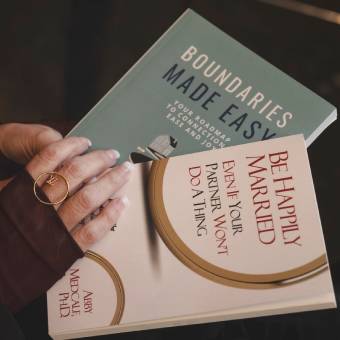
If boundaries are a big issue for you, I’m going to lovingly suggest that you get my book Boundaries Made Easy or The Boundaries Made Easier Workbook. In both, I dive deeper and give a ton of tips and worksheets you can use to get great at boundaries.
For now, though, I want to give you something that’s not in my books. It’s a five-step method you can use at work today. You can remember it with the acronym BRAVE.
This framework distills the five steps I teach in companies, coaching, and keynotes.
Here’s how it works:
B: Be Clear and Concrete
Don’t say, “I’m slammed.” Say, “I’m unavailable after 5:30 and won’t be responding to messages until tomorrow morning.” People don’t respond to ambiguity. They respond to clarity. Vague boundaries don’t work because they leave too much room for interpretation. And let’s be honest, interpretation usually sounds like, “Oh, she didn’t mean me.”
R: Repeating Only Once and No Justifying
Once you set a boundary, don’t repeat it more than once and, never give reasons why. You don’t owe anyone a PowerPoint on why you’re unavailable. The more you explain, the more they’ll find a workaround or poke holes in your logic.
Example:
Coworker: “Can you just squeeze this in tonight?”
You: “I’m unavailable this evening.”
Coworker: “But why? Are you just going to dinner or something?”
You: “I’m unavailable this evening.”
Rinse. Repeat. Smile if you’re feeling spicy.
A: Align with Priorities
Your boundaries must align with your goals or no one will respect them, including you. If you’re setting limits just to “feel less stressed,” that’s too abstract. Instead, filter all requests through your professional priorities:
- Does this move me toward my top three outcomes this quarter?
- Is this mine to handle, or am I rescuing someone?
- Is this urgent or just poorly planned?
Boundaries are easier to hold when you’re protecting something that matters. It’s not just about saying no. It’s about saying yes to what’s most important.
V: Validate Without Caving
You can be compassionate and still say no.
Say things like:
- “I know this is frustrating.”
- “I get that you’re in a tough spot.”
- “If I had capacity, I’d help.”
Then stop talking. Boundaries don’t require you to be cold or robotic. They require you to be steady and consistent. Validation helps the other person feel seen and takes the fight out of their pushback, while you hold the line.
E: Expect Pushback
You’re not being dramatic. You’re being strategic. Pushback isn’t a sign that your boundary is wrong. It’s a sign that it was long overdue. People often resist the first few times you hold a boundary, especially if you’ve been the go-to, always-say-yes person. Expect it. Let it come. And stick to your line.
Why Boundaries Matter Now More Than Ever
Since the pandemic, the average global workday has increased by almost an hour. Remote workers experience more burnout than those who are in the office, and 76% of workers say job stress affects their mental health¹.
In the U.S., about 75% of employees report feeling burned out at least sometimes, and roughly 25% feel burned out “very often” or “always.” Burned-out employees are more likely to take sick days, visit the ER, and feel disconnected from their families.
In other words, boundaries aren’t just a nicety. They’re essential for your health, your relationships, and your performance.
Scripts for the BRAVE Boundary Method in Action
Try these ready-to-use scripts:
- When your boss pings you late at night:
“I saw your message come in after hours. I’ll respond first thing in the morning.” - When a coworker tries to guilt you into more work:
“I’m at capacity this week and can’t take that on.” - When your calendar gets hijacked by back-to-back meetings:
“I need a buffer in my afternoons to do focused work. I’m unavailable for recurring meetings between 1 and 3 p.m.” - When someone challenges your no:
“I know it’s frustrating. I wish I could help, but I’m not available.” - When you’re feeling pressure to justify:
“I’ve made a commitment to a hard stop at 5:30. Let me know if we need to reprioritize.”
What If My Boss Is the Problem?
If your manager is the one bulldozing your boundaries, it’s time to lean on clarity.
Use my “I’m confused” strategy: “I’m confused. The priorities we’ve outlined take about 10 hours a day to complete. Are you asking me to work 10-hour days?”
This isn’t about calling them out. It’s about clarifying expectations. Most managers aren’t trying to push you past your limits; they’re just unaware of how unrealistic the workload has become. By calmly stating the facts and staying in problem-solving mode, you give them a chance to collaborate instead of dominate.
Boundaries Are Trained, Not Told
You don’t just set boundaries. You teach them.
And like any good training, it requires consistency, reinforcement, and follow-through.
You might not get applause. You might get some side-eye. But you’ll also get:
- More respect
- More energy
- More time for the work that matters
And maybe most importantly? You’ll stop resenting everyone around you. That’s a win.
Put Today’s Lesson into Action
If this topic resonates with you and you want more support, you can get my free BRAVE Boundary Toolkit. This one-pager has:
- The full BRAVE Boundary Method
- Five scripts you can use immediately
- Three reflection questions to help clarify your most important limits
Train Your Team to Respect Your Boundaries and Grab the Toolkit
Resources for Why No One Respects Your Work Boundaries (and How to Change That)
Boundaries Made Easy: Your Roadmap to Connection, Ease and Joy by Dr. Abby Medcalf
The Workbook: Boundaries Made Easier by Dr. Abby Medcalf
Harter, Jim. (2023) Globally, Employees Are More Engaged — and More Stressed, Workplace Gallup.
Pew Research Center. (2021). Even in industries where majorities can telework, some face challenges.