


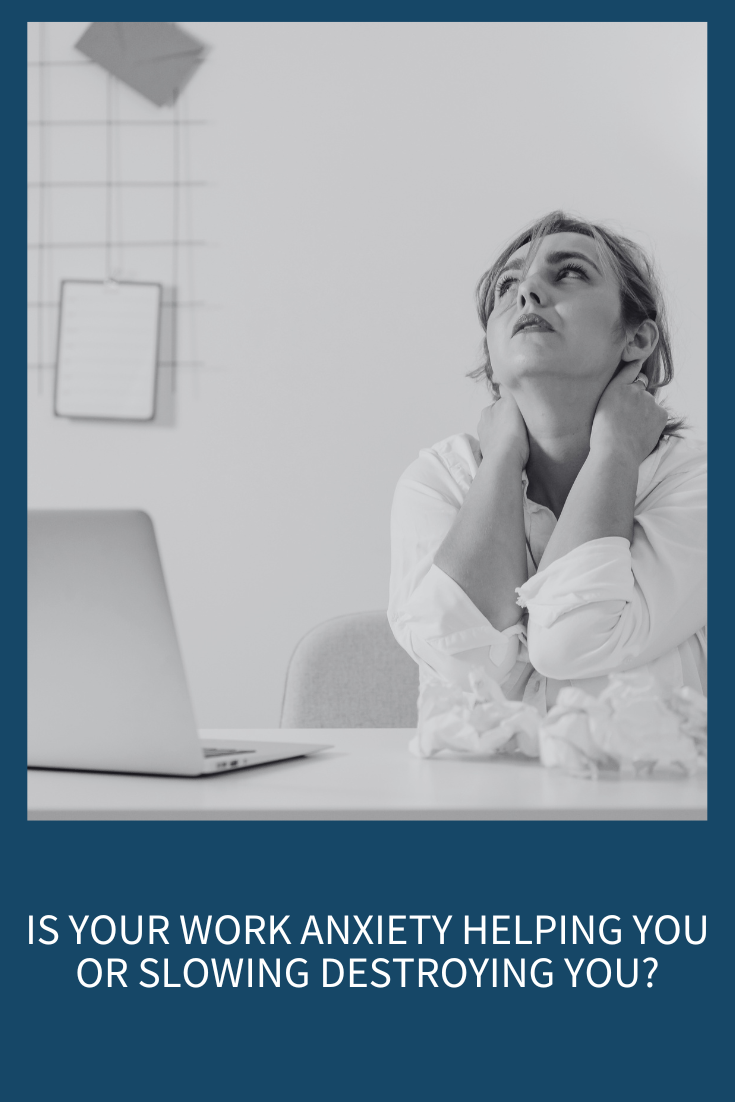
Anxiety at work is practically a badge of honor in many high-achieving environments. You’re praised for staying up late to “double check” the deck or constantly monitoring your inbox “just in case.” But here’s the truth: while some anxiety can help you perform better, too much of it will wreck your productivity, your confidence, and your health. So how do you know when your anxiety is helpful and when it’s just running you ragged? Today we’ll break down the difference, the psychology behind it, and a simple five-step strategy to get back in the driver’s seat when anxiety shows up at work.
6-minute read
Yes, Some Work Anxiety Is Actually Helpful
Anxiety isn’t always a problem. From an evolutionary standpoint, anxiety is your brain’s alarm system. It kicks in when there’s potential danger or uncertainty so you can prepare, protect, or perform. At work, healthy anxiety often shows up as:
- Nervous energy before a big meeting that motivates you to prepare
- Feeling on edge before a deadline that pushes you to focus
- Being concerned about how your work will be received because you care
The research shows that this type of moderate anxiety can improve alertness, motivation, and task performance, especially for complex tasks that require attention to detail. It’s known as adaptive anxiety which is stress that’s in proportion to the situation and that serves a purpose.
This is also supported by something called the Yerkes-Dodson Law, which is a well-established principle in psychology showing that performance increases with physiological or mental arousal, but only up to a point. Once you move past that optimal threshold, things start to go sideways.
But Most Workplace Anxiety Isn’t Helping You
Where anxiety becomes toxic is when it’s constant, out of proportion, and starts driving your decisions. This is where we move into maladaptive anxiety when your stress response becomes chronic, habitual, or fear-based.
Common Signs Your Work Anxiety Is Hurting You:
- You overprepare to the point of paralysis and still feel unready
- You avoid giving feedback or speaking up because you’re afraid of conflict
- You obsess over Slack messages or emails and ruminate on tone or wording
- You agree to tasks or timelines you don’t have capacity for because you’re afraid of being perceived as lazy or uncommitted
- You procrastinate, then punish yourself for procrastinating
These patterns can actually decrease performance and job satisfaction over time. In fact, chronic anxiety has been associated with impaired decision-making, reduced creativity, emotional exhaustion, and lower productivity.
It also affects your physical health. Research shows that persistent anxiety activates the hypothalamic-pituitary-adrenal (HPA) axis, leading to elevated cortisol levels, increased inflammation, and immune suppression. Not exactly ideal for that big pitch.
The Psychology of Why This Happens
Your anxiety at work isn’t random. It’s the result of both your biology and your past experiences. Neurologically, anxiety is tied to amygdala activity and prefrontal cortex regulation. When you perceive a threat, real or imagined, your amygdala fires off an alert. Your body prepares for fight, flight, or freeze. But when this system is overactive, you respond to a critical email the same way your ancestors responded to a bear in the woods.
Cognitively, people with high workplace anxiety often experience something we psychologists call intolerance of uncertainty. Basically, you become hypersensitive to ambiguity, mistakes, or potential negative outcomes. This leads to excessive checking, reassurance-seeking, or rumination.
You might also be dealing with learned behaviors: perfectionism reinforced by praise, people-pleasing tied to early experiences of conditional approval, or trauma responses that show up as hypervigilance in performance settings.
A Quick Process to Handle Work Anxiety in Real Time
You don’t need to eliminate anxiety. You just need to learn how to respond to it more intentionally. When your nervous system takes over (aka: you’re triggered in some way) it’s hard to remember or use any tool you’ve learned (even my wonderful ones).
Here’s a five-step strategy grounded in research from emotion regulation and cognitive-behavioral therapy to help you find balance and peace again:
Step 1: Name It
The first step is to name the feeling(s). Instead of powering through, pause and say to yourself, “I’m feeling anxious right now”. Labeling your emotional state activates your prefrontal cortex and reduces amygdala reactivity, helping you calm down. It’s also important to remember to say that you’re feeling something not that you are something. So, “I’m feeling anxiety” vs “I’m anxious.” This is another research-based approach called self-distancing which is also very effective in creating space between you and your feelings so helps lessen anxiety.
Try this: “This is anxiety, not fact. I don’t need to act on it immediately.”
Step 2: Neutralize It
It’s impossible to move forward if you’re feeling paralyzed. Naming the emotion(s) is a start but if you’re triggered, then your biology is ruling and you can’t access the part of your brain telling you to calm down. So, now you need to neutralize or unhook your brain’s fear system.
My download for today is a free Workplace Grounding Toolkit, where I’ll give you five nervous system resets you can do at your desk in under two minutes.
Step 3: Normalize It
We know from the self-compassion research that normalizing something will help you calm down and realize that you’re (really) just like most people. You’re not broken. So, now you’d say something to yourself (or out loud) such as: “Anyone would feel anxious, at least a little, if they had to speak in front of a lot of people” or “It makes sense that I’m feeling so much anxiety given that I grew up in a house where, if I made one mistake, I was punished or ridiculed.”
Step 4: Notice the Narrative
Research from cognitive behavioral therapy shows that when you can change the meaning or point of view of your thinking, you can drastically change how you feel about something because you feel the way you think. So now you’re going to ask, “What’s the story I’m telling myself about this?” or “What else could be true about what’s happening right now?”
Step 5: Navigate It
Lastly, you need to navigate or move yourself towards something healthier. Now that you’ve done these steps, what’s next?
- Now I’m going to go into the meeting and talk about my new idea
- Now I’m going to speak to my coworker about what upset me
- Now I’m going to take a quick walk outside to clear my head and re-set
- Now I’m going to do a quick meditation to re-set
You can also ask yourself, “What would I do if I trusted myself here?” Then do that thing. Even if it’s small. Especially if it’s uncomfortable. This helps retrain your brain to see values-based action as safe and effective.
Research from Acceptance and Commitment Therapy shows that acting in alignment with your values, even when anxiety is present, leads to reduced psychological distress and improved workplace resilience.
Try this: “I’m going to reply to this email directly, not dance around what I need. Even if my hands are shaking.”
Final Thoughts: You Can Be Anxious and Still Be Effective
You don’t need to feel confident before you take action. You don’t need to wait until the anxiety goes away. You just need to be clear about what you care about and brave enough to act on it.
Anxiety doesn’t have to run your day. When you learn to name it, decode it, and respond from your values instead of your fears, you show up with more clarity, confidence, and integrity, even if your stomach is flipping.
Put Today’s Lesson into Action
Grab The Workday Grounding Toolkit, 5 nervous system resets you can do at your desk in under 2 minutes
Resources for Work Anxiety: The Difference Between Helpful Stress and Harmful Overload at Work
How to Stop Being a Perfectionist So You Can Start Being Happy
You Might Not Realize You’re Suffering from Unhealed Trauma
What to Do When You Can’t Stop Thinking About Something
How Your Lizard Brain is Keeping You Stuck