

You always wait. You wait for the phone call from your partner, the text from a friend, the counselor’s time, maybe even your parent’s voice to calm you. But what if I told you that waiting is costing you your power? That you are the single most reliable person you’ll ever have to calm you down, and until you claim that, you’ll keep showing up in your relationships needy, reactive, or out of sorts.
Today we’re going to uncover why you habitually reach for someone else first, how that pattern affects the one relationship you can’t escape (the one with you), and most importantly, I’ll give you five research-backed self-soothing tools you can start using right now, so you don’t have to wait for rescue.
12-minute read
Why You Reach Out for Assurance/Validation First
There are three main reasons why you reach out before you reach inward: there’s an overlap between your attachment history, validation-seeking behavior, and some emotional regulation short-cuts you’re taking.
- Attachment and the Urge to Reach Out: Research shows that people with anxious attachment are more likely to use reassurance-seeking behaviors when they’re distressed. Their internal working models tell them that if someone else doesn’t step in, they aren’t safe. That instinct to call someone comes from a place that says: I’ll only feel okay if someone else gives me the signal. It generally means that in your early years, your nervous system learned to rely on someone else to soothe. You didn’t learn how to soothe yourself.
- Validation & External Signals: Beyond attachment, you may also be wired for external validation. You’ve learned (maybe unconsciously) that your worth is tied to someone else saying, “Yes, you’re okay.” That’s something called your approval-seeking schema in action. A schema is basically a mental framework that helps you organize information. It’s like your brain’s file folder system. If you have an approval-seeking schema, it means that’s one of the ways your brain filters and sorts information. So, when you feel unsafe, you look outward for that signal, “Tell me I’m okay. Tell me I’m safe.”It’s not inherently bad to think this way. I mean, human beings are relational after all. But when that becomes your first and only move, you give away your emotional power.
- Emotion Regulation Gap: This is the third piece of why you reach out for validation first. Your nervous system is built to regulate. But if you haven’t practiced self-regulation (self-soothing) much, the easiest path becomes: “Someone else fix this so I don’t feel bad.” Research on self-regulation shows that adults who regulate emotions themselves (rather than always relying on external calming) tend to have healthier outcomes.In short, you reach out first because it’s been what works. But here’s your insight: it works temporarily and externally. What you’re about to do is build internal work that changes the equation.
The Deeper Cost: What It’s Doing to You
Okay, so you do this. You call someone when you’re upset. You wait for reassurance, comfort, or connection so you feel “back to baseline.” But the cost is real and chronic in three main ways.
- Nervous System Impact: When you leave regulation to someone else, your autonomic nervous system remains in a “waiting for rescue” mode. You stay in elevated arousal (higher heart rate, faster breathing, and less capacity to think clearly). Studies of self-soothing behaviors define self-soothing as the process of intrinsic self-directed efforts to calm distress and return to baseline. If you skip that step repeatedly, you remain in a state of dysregulation.
- Relational Impact: One study found that people who engage in excessive reassurance-seeking behaviors generated negative effects on partner trust the next day. If you’re always “Hey, are you there? Hey, do you still care? Help me calm down,” it can become less about connection and more about an emotional lifeline. That puts pressure on you and the other person, which erodes relationship trust when it happens often.Also, studies show that insecure attachment (which fuels this pattern) correlates with poorer psychological well-being and relational satisfaction. So the pattern isn’t just “annoying,” it’s relationally and personally costly.
- Cost to Your Relationship with Yourself: When you’re constantly turning outward for calm, you’re sending a message internally: “I can’t trust myself to bring myself to safety.” That erodes self-confidence. You become someone who needs external validation just to feel okay. That’s not the position you want to be in.So yes, the costs are invisible but real. Nervous system strain. Relational friction. Self-trust breakdown. The good news is you can do something about it.
Five Self-Soothing Tools You Can Start Today
Learning to self-soothe is a skill. And, like any skill, it takes practice and consistency to get good at it. You can start with these five tools. Use them. Practice them. Build the muscle so you don’t always reach outward.
A quick note that, not only am I about to give you these five amazing tools, but the free download for today’s episode is a self-soothing toolkit I’m calling: Your Calm Is in Your Hands: 5 Ways to Self-Soothe Like an Adult.
Tool #1: Sense-Anchors (Touch/Scent/Sound/Taste/Sight)
When you engage your senses intentionally (touch, smell, sound, taste, sight), you shift the pathway of your distress from the swirling emotional loop into the more stabilizing territory of your body and environment. In other words, rather than staying trapped in “I feel out of control” mode, sensory engagement invites you: “Look, feel, hear, taste, or smell something that anchors you in the here and now.”
Clinical literature supports this: grounding techniques that engage sensory input help people who are dissociating, overwhelmed by memories, or stuck in emotional reactivity to become aware of the here and now. Further, studies using physical- and sensory-based grounding interventions (for example, movement, awareness of body contact, tactile stimulation) show measurable reductions in anxiety, depression, and improved regulation of emotional arousal in comparison to control groups. Simply put: you don’t have to wait to “feel calm”. You can activate calm by pulling your nervous system into sensory contact with what’s under your feet, what’s against your skin, what you can hear or smell, right now.
Example: You had a tense conversation with your teen. You leave the room for 90 seconds. You wrap your favorite blanket (touch) around yourself. You inhale the scent of your favorite essential oil (smell). You take a slow sip of herbal tea (taste+smell). You look at a photo of a place you love (sight). You play a 90-second track of the song you saved for “reset” (sound).
You-voice script: “Body, you’re rattled. I anchor you. Blanket. Breath. Tea. Calm.”
Tool #2: Breath + Voice Activation
Slow, controlled breathing combined with gentle vocal humming or tones engages your body’s internal regulation system in two powerful ways. First, prolonged, paced exhales stimulate the vagus nerve, a major part of your parasympathetic (“rest & digest”) nervous system. Research describes how regulated respiration can phasically and tonically stimulate the vagus nerve, shifting autonomic balance toward calm.
Second, humming or gentle vocalization creates vibratory feedback in the throat and chest, which further supports vagal activation. One study showed humming significantly lowered the stress index and improved heart-rate variability (HRV) compared to physical activity or a stress condition.
Example: You’re waiting for a tough phone call, or you’ve just walked away from a charged conversation and your chest is tight, your mind is racing, and your impulse is: “I need to talk to someone.” Instead, you sit upright in a comfortable chair (feet grounded). Inhale through your nose for 4 counts (notice your belly expand). Then exhale slowly through your mouth or nose for 6-8 counts while humming a soft “mmm-mmm” sound until the exhale ends. Repeat this 4-6 times. After the last hum, say softly to yourself: “I’ve got you. You’re safe. I’m here for you.”
You-voice script: “Breathe in. Feel your belly expand. Now hum on the out-breath. One more time. Good. You are slowing down. You are here. I’ve got you.”
Tool #3: Name the Feeling & Frame It
Simply putting your internal experience into words, such as “I feel X,” or “My heart is racing,” activates a regulatory process in your brain called affect labeling. Studies show that when we name our feelings, activity in the amygdala (the brain’s alarm center) goes down, and activity in the ventrolateral prefrontal cortex (a region linked to regulation and choosing) goes up. This means you move from reactive “What’s happening to me?” mode to reflective “What am I feeling and what will I do?” mode.
One neuroimaging study found that affect labeling, again, simply naming the emotion that popped up in a stressful image, reduced self-reported distress and dampened neural response in the amygdala. And I found another study showing that affect labeling was more effective than passive watching in lowering emotional reactivity.
Example: You’ve just been passed over for a project at work, and you feel a hollow-sting of rejection mixed with anger. Rather than immediately picking up your phone to talk it out, you pause. You think or whisper: “I feel … disappointed. I feel … invisible. My chest is tight; my mind is racing about fairness.”
Then you add a frame: “It makes sense I’d feel this because I cared about the chance, because it touched my sense of worth. But I’ve got time; I can choose what to do with this.” Then you ask: “What do I need right now to bring myself back to baseline?” Maybe it’s a 2-minute walk, maybe it’s jotting a sentence, maybe it’s one of the self-contact moves below.
You-voice script: “I feel disappointed and unseen. That makes sense. What move will serve me now?”
Tool #4: Self-Contact (Safe Body Part)
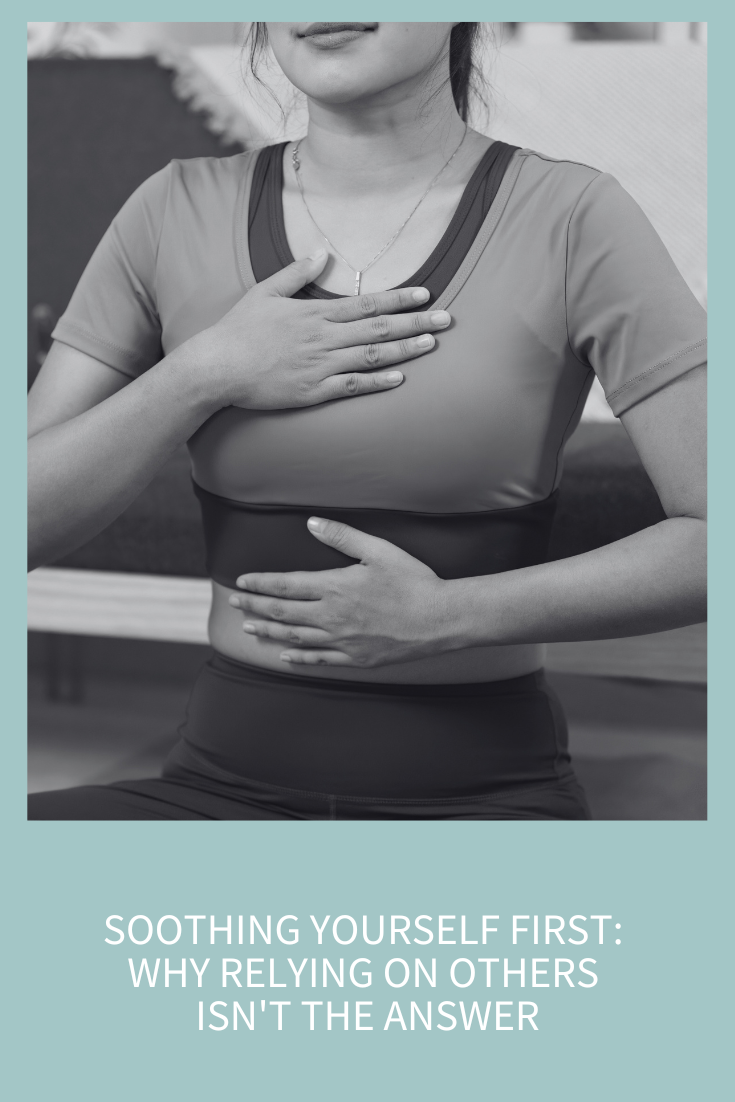
When you place your hand on your heart, belly, or another “safe body part,” you activate soothing touch signals that bring your nervous system into a calmer state. Studies show that self-soothing touch or physical contact can reduce cortisol (the stress hormone) in response to a stressor, and activate neural pathways connected with affect regulation. A separate review on affective touch finds that tactile contact plays a key role in self-regulatory processes, especially when other people aren’t available.
Example: You just finished a heated exchange with a loved one and your chest is tight, your mind buzzing with “I should’ve said…” or “Why did I…” Instead of picking up your phone to seek someone’s reassurance right away, you pause. Sit or stand. Place one hand gently over your heart (or your belly if that feels more grounding). Close your eyes for a moment. Inhale for 4 counts, exhale for 6 counts. On the exhale think: “I’m here for you.” Breathe one more cycle, then say: “I’ve got you. You’re safe.”
You-voice script: “Hand on heart. Grounding breath. Message: I’m safe. I’ve got you.”
Tool #5: Mini-Ritual + Habit Building
Establishing a short, structured ritual creates a bridge between your stressed state and a calmer state. Research shows that rituals (defined as repetitive, meaningful sequences of action) have measurable regulatory functions for emotion. They help you feel you’re doing something purposeful, give your nervous system a predictable cue that “we’re shifting now,” and anchor your internal state in the present rather than the swirl of reactive chaos. One study I found showed that participants who performed a simple ritual after an anxiety induction had lower self-reported and physiological anxiety compared to a control group.
Example: You wrap up your workday, but your brain is still buzzing and your body feels tight. Instead of allowing the “off-switch” to be default chaos, you pause for 2-3 minutes. Stand, stretch your shoulders, place your favorite scarf/blanket around you (sensory cue on top of ritual). Say to yourself: “I’m shifting out of work mode and into human mode.” Activate one sensory anchor (e.g., lighting a candle, playing a short 90-second calming sound clip). Take a breath: inhale 4 counts, exhale 6, while your hand rests on your belly (or heart). Think: “Right now I feel X and I choose Y.” Then you move on to your evening with the message: I’ve oriented myself.
You-voice script: “Stand. Stretch. Wrap the scarf. One breath deep. I am shifting. I’ve got me.”
What Changes When You Own Your Calm
There are three main outcomes my clients report when they start owning their calm.
Shift #1: With Yourself
You become your own first responder. Instead of the usual panic → call → scramble, you get: pause → choose → act. Your nervous system becomes less reactive, you become more grounded, your internal voice is stronger. You build self-trust. Because you see: I can handle this. You don’t need perfect, you need practice.
Shift #2: With Others
You show up calmer. When you’re less reactive, you’re more present. You’re less “I need you to soothe me” and more “Here I am, whole, and available.” That changes everything. Your partner/friend isn’t your regulator; they’re your companion. That grows intimacy, respect, and healthier dynamics.
Shift #3: In Your Relationships
When you regulate, you bring steadiness. You create boundaries not from fear but from clarity. You give less emotional freight to others. You show up from your highest self, not your reactive self. That shifts how people respond to you and how you feel about yourself.
Mini Self-Soothe Protocol (Use It Right Now)
Here’s a script you can run before you pick up the phone:
- Ground: Stop. Feet planted. Sit/stand. Inhale 4 counts, exhale 6 counts.
- Sense-Check: Choose one sensory anchor: blanket, scent, song. Use it now.
- Name & Frame: “I feel X.” “It makes sense because Y.”
- Breath + Voice: Inhale. Exhale with hum “mmm”. Do this 3x.
- Self-Contact: Hand on heart/belly. Press gently. Say: “I’m here for you.” One more breathing cycle.
- Choose your next step: Ask: “Do I call someone now or do I take two more minutes for me and then decide?” Then act.
Final Words
You don’t have to keep waiting for someone else to calm you down. You can train yourself to be your own calm. That doesn’t mean you’ll never need someone else, it means you won’t depend on someone else as your only path. You’ll step into your relationships from strength, not from need. You’ll show up whole, not fragmented by seeking. Use the tools. Practice. Build your muscle. Because the calm you were waiting for? It was inside you all along.
One Love Collective/Therapy-to-Go Bundle:
- Your Calm Is in Your Hands: 5 Ways to Self-Soothe Like an Adult
- Journaling Prompts
- The 7-Day Self-Soothing Challenge
- Find Your Calm Triggers: A Guide to Discovering Your Personal Sensory Anchors
- Self-Soothing Conversation Scripts
- The Self-Soothing Routine Tracker
Buy the bundle now for $10 and get all the above. OR join Abby’s One Love Collective and get a Therapy-to-Go Bundle for each episode, plus ad-free episodes of the podcast, live Q&A’s with Dr. Abby, and access to an amazing community that’s all about real growth.
Resources for When You Can’t Wait for Someone to Calm You Down: How to Self-Soothe Like an Adult
Download the Therapy-to-Go Bundle for this episode
Join Abby’s One Love Collective on Substack
Seven Powerful Techniques to Breathe Yourself to Calm
How Your Attachment Style Affects Your Personal Relationships
The Attachment Project: Early Maladaptive Schemas, Approval-Seeking/Recognition-Seeking
Gross, J. J. (Ed.). (2014). Handbook of emotion regulation (2nd ed.). Guilford Press.