

Have you ever felt guilty for wanting space? Like needing a little distance from someone you love means something is wrong with you, or with the relationship? Or maybe you’ve watched someone you’re dating and thought, “Why does their family seem to know everything about everything and have an opinion on all of it?” What you might be looking at, in both cases, is enmeshment. Today we’re talking about what enmeshment actually is, how to recognize it in yourself and in the people around you, and why the line between being close and being enmeshed matters more than most people realize. I’ll give you the signs across romantic relationships, family dynamics, and friendships, including what to watch out for if you’re dating someone from an enmeshed family. And I’ll give you tools to start untangling it without blowing up the relationships that matter to you.
17-minute read
What Is Enmeshment?
Enmeshment is what happens when the boundaries between two people, or between members of a family, become so blurred that individuality starts to disappear. It’s not the same as being close. It’s not the same as loving someone deeply or wanting to spend a lot of time with them. Enmeshment is a specific pattern where one person’s emotions, identity, and decisions become so fused with another’s that it’s hard to tell where one person ends and the other begins.
The term was coined by my hero and mentor, family therapist Salvador Minuchin in the 1970s. Minuchin used it to describe families where the level of involvement between members was so high that normal boundaries of independence and privacy had essentially collapsed. In his framework, enmeshment sat at one extreme of a continuum, the other extreme being disengagement, and healthy relationships lived somewhere in the middle.
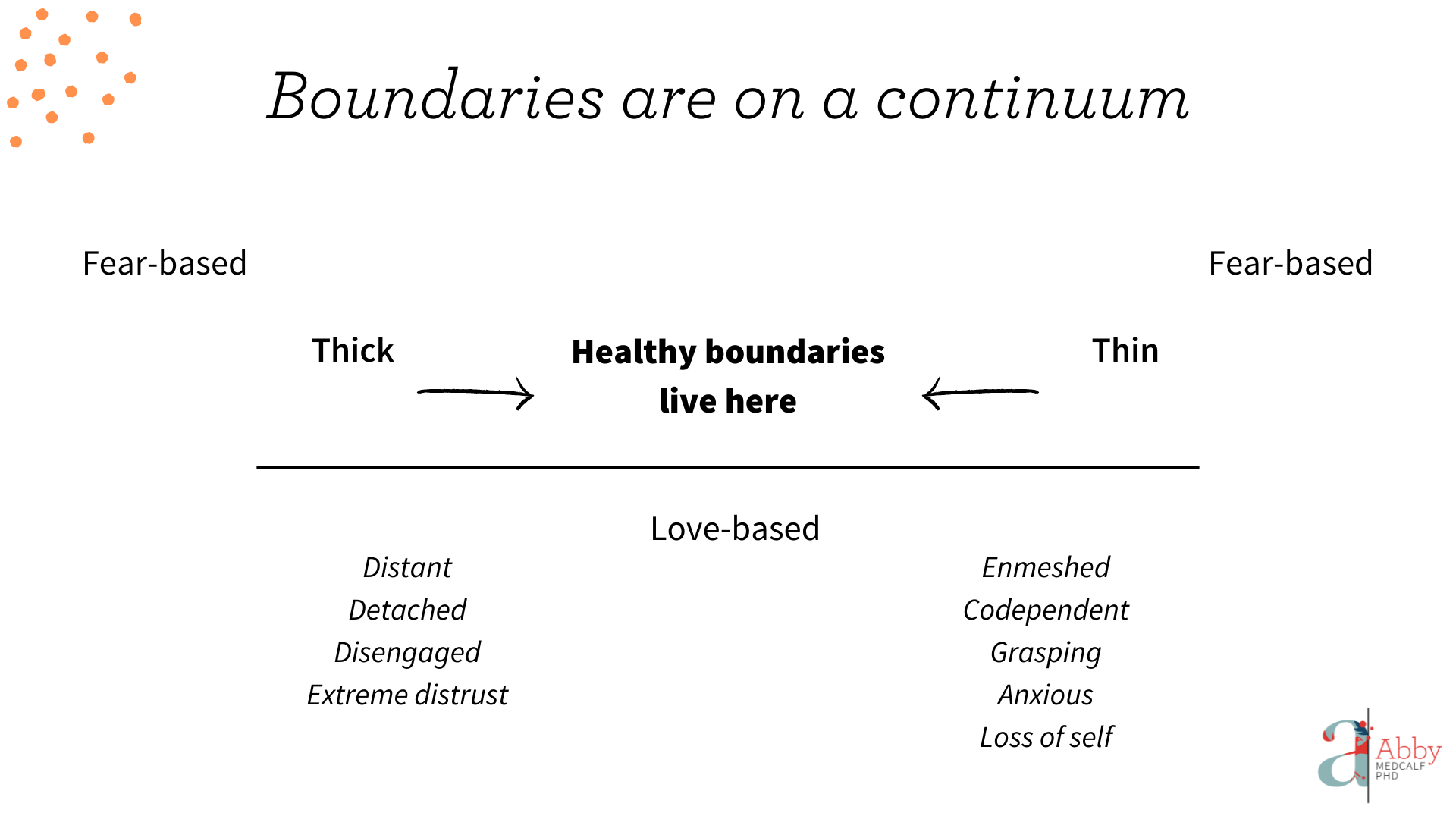
I’ve been teaching a version of this continuum for decades in my work and in my book, Boundaries Made Easy. I describe it as a spectrum from thin, enmeshed boundaries on one side to thick, emotionally distant boundaries on the other. Both extremes are fear-based, and both are equally unhealthy. Understanding where you fall on that spectrum is the first step to changing it.
The Thin-to-Thick Boundary Continuum
When boundaries are too thin, you’re enmeshed. When they’re too thick, you’re emotionally cut off. Neither extreme is healthy, and here’s what surprises most people: they’re actually two sides of the same coin, both driven by fear.
On the thin side, you’re essentially saying, “I am my relationship.” Your emotional wellbeing rises and falls entirely on what the other person is doing or feeling. On the thick side, you’ve gone so far in the other direction that you’ve walled yourself off. You don’t let anyone in. And interestingly, I see people swing from one extreme to the other all the time, especially in moments of conflict. Someone who’s been enmeshed and compliant can suddenly slam the door entirely when they feel they’ve lost control. That’s not a boundary, it’s a wall.
The goal is to live somewhere in the middle of that continuum, where you can be genuinely close, genuinely vulnerable, and genuinely connected, without losing yourself in the process. Boundaries from that center place come from love. They’re about keeping people in, not keeping people out. Enmeshment, even when it looks like love, is fear-based. It’s about managing anxiety, not creating real connection.
How Is Enmeshment Different from Codependency?
This is a question I get a lot, and it’s a fair one because the two concepts overlap significantly. Codependency is about depending on something outside yourself, usually another person’s behavior or approval, to provide your sense of wellbeing. Enmeshment is the relational structure that often makes codependency possible. Think of it this way: enmeshment is the blurring of boundaries between two people. Codependency is one of the things that can grow out of that blurring.
You can be in an enmeshed family system and not be codependent in every relationship you’re in. And you can have codependent tendencies without being in a classically enmeshed relationship. But they frequently show up together, and both are rooted in the same fear-based soil. If you’ve ever felt like another person’s bad mood was somehow your fault to fix, or felt guilty for having a different opinion from a family member, you’ve experienced the overlap.
I’ve talked about codependency before here on the podcast, and I’ve discussed more recently the difference between codependency and compassion, so I won’t rehash all of that here. What I want you to understand today is that enmeshment is its own distinct pattern worth understanding, even if the two are related.
Signs You’re in an Enmeshed Romantic Relationship
In romantic relationships, enmeshment often gets mistaken for deep love or intense connection, especially early on. The fusion can feel exciting. But over time, it tends to create anxiety, resentment, and a creeping sense that you’ve lost yourself somewhere along the way.
I worked with a couple a few years ago, two people who were genuinely devoted to each other, but the woman came in saying she felt like she was “disappearing.” She couldn’t articulate exactly what was wrong because nothing was wrong in the conventional sense. Her partner wasn’t unkind. He wasn’t unfaithful. But she’d noticed that she’d slowly stopped having opinions. When he wanted Thai food, she wanted Thai food. When he was stressed about work, she was stressed about work. When he thought a movie was bad, she’d decide she hadn’t liked it either, even if she’d walked out of the theater thinking it was great. She’d lost her own inner compass entirely, and she hadn’t noticed it happening.
Here are the signs to watch for in a romantic relationship:
- You feel responsible for your partner’s emotional state, even when you had nothing to do with causing it.
- You can’t relax until they’re okay. Their mood is essentially your mood.
- You feel guilty when you do something independently, whether that’s seeing a friend alone, pursuing a hobby, or making a decision without checking in first.
- There’s very little “me” in the relationship. Everything is “we,” including friendships, which are either shared or quietly dropped.
- You’ve stopped having opinions that differ from theirs, or you’ve noticed yourself abandoning your own views to avoid tension.
- Conflict or even mild disapproval from your partner triggers a level of anxiety that feels disproportionate to the situation.
- You feel the need to know where they are and what they’re doing at all times, and the same goes for them with you, and it doesn’t feel like loving attentiveness; it feels like surveillance.
Signs You’re in an Enmeshed Family System
Family enmeshment is where this pattern most often originates. If you grew up in an enmeshed family, it can be genuinely hard to recognize because it was your normal. And it often looks like love from the inside, even when it’s costing you something significant.
Signs of family enmeshment include:
- As an adult, you still seek a parent’s approval before making significant decisions, or you feel intense guilt when you don’t.
- Having a different opinion from your family feels dangerous, disloyal, or simply not allowed.
- A parent treats your independent choices, your career, your partner, your city of residence, as personal affronts to them.
- You feel responsible for a parent’s happiness or emotional stability, and you’ve felt that way since you were a child.
- There are no real secrets allowed in the family. Everyone’s business is everyone else’s business, and privacy feels like rejection.
- You find it almost impossible to say no to a family member without enormous guilt, even when the request is unreasonable.
- Family members speak for each other, make decisions for each other, or expect to have a vote in each other’s major life choices well into adulthood.
- You see or speak to one another quite frequently, sometimes multiple times a day. There are lots of family vacations and assumptions that certain times will be spent together. When that doesn’t happen, there’s tremendous guilt, sometimes anger, and/or being given the cold shoulder.
Signs You’re in an Enmeshed Friendship
Friendships can become enmeshed too, and this one tends to sneak up on people because healthy friendships are supposed to involve mutual care and investment. The difference is that enmeshed friendships start to require you to disappear a little in order to maintain them.
I had a client who came to me because she felt exhausted in a close friendship and didn’t know why. Her friend wasn’t mean. She wasn’t using her. But my client had realized that she’d started dreading their calls. When the friend was having a hard week, my client’s whole week went sideways with it. She’d stopped making plans with other people without checking if her friend was available or “okay” with it. And she’d noticed herself editing what she said and felt to avoid rocking the boat. That’s enmeshment in a friendship.
Watch for these signs:
- One friend’s mood or crisis dictates the emotional tone for everyone in the friendship.
- You feel guilty making plans with other people, especially if it doesn’t include this friend.
- You can’t make decisions, even small ones, without checking in with this person first.
- There’s an unspoken rule that loyalty means total availability, and stepping back in any way feels like a betrayal.
- You’ve lost other friendships or interests because this one relationship has gradually taken up all the relational space.
Warning Signs You’re Dating Someone from an Enmeshed Family
This is one that doesn’t get talked about enough, and it matters enormously if you’re in or considering a serious relationship. When your partner comes from an enmeshed family system, you’re not just dating them. You’re dealing with the entire dynamic they were raised in, and if they haven’t done the work to differentiate from it, that system will show up in your relationship in very concrete ways.
I’ve seen this derail countless relationships, not because anyone was a bad person, but because no one saw it coming or knew how to name it. Here’s what to look for:
- Their family has strong, often unspoken opinions about who they should be with, and those opinions carry real weight in their decision-making, even as an adult.
- A parent calls or texts constantly, and your partner feels unable to create any limit around it without enormous guilt.
- Important relationship decisions, where you’ll live, whether to have children, or major financial choices, go through their family of origin before they’re finalized with you.
- You get the sense that any conflict between you and a family member will be resolved in the family member’s favor, because your partner doesn’t have the tools to advocate for the relationship.
- Family members know details about your relationship that you consider private, because your partner shares everything with them.
- Your partner becomes dysregulated, guilty, or visibly anxious around any family visit or call, and that dysregulation spills into your dynamic.
- When you raise concerns about the family dynamic, your partner defends it fiercely or shuts down entirely, because the enmeshment is so normalized, they can’t see it yet.
None of this means the relationship is doomed. But it does mean that both of you need to be clear-eyed about what’s happening and whether your partner has the willingness to do the differentiation work that a healthy partnership requires.
3 Tips If You’re Already in This Relationship
If you recognized your relationship in that list and you’re wondering what to actually do about it, here’s where to start.
Tip 1: Name what you’re seeing before you try to change it.
Before any conversation about the family dynamic can go anywhere useful, your partner needs to be able to see it. That’s a process, not a moment. Pointing it out directly and early, especially when they’re feeling defensive, usually backfires, and you end up looking like the problem. Instead, start by naming your own experience without framing it as an indictment of their family. “I feel like we don’t get to make decisions together before they’re run by your mom, and that’s hard for me” lands very differently than “your family is enmeshed and it’s affecting us.” Your goal in early conversations is to make it safe for them to look, not to convince them of something they’re not ready to see.
Tip 2: Decide what you can and can’t tolerate, and be honest about it.
This is where a lot of people avoid doing the real work because it requires honesty that feels uncomfortable. You need to get clear on what’s actually workable for you and what isn’t. Is it workable that your partner talks to their parent daily, as long as the content of your relationship stays private? Is it workable that holidays are a little complicated, as long as major decisions belong to the two of you? Or is the level of enmeshment so pervasive that there’s genuinely no room for your relationship to develop its own identity? These aren’t rhetorical questions. They’re the questions you need to actually answer, because staying without answering them is how you end up resentful three years from now without knowing quite why.
Tip 3: Keep your own life intact.
One of the most common things I see when someone is in a relationship with a person from an enmeshed family is that the outsider slowly starts shrinking too. They stop advocating for their own needs because every attempt creates conflict. They start organizing their life around the family’s calendar and preferences. They lose their own sense of what they want. Don’t let that happen. Your differentiation, your ability to stay grounded in who you are and what you need, is not a threat to the relationship. It’s actually the healthiest thing you can bring to it. A partner who models what it looks like to be a full, boundaried, self-possessed person is sometimes the most powerful catalyst for change in someone who was never given permission to be one.
Why Does Enmeshment Happen?
Enmeshment almost always has its roots in anxiety and attachment. When caregivers are anxious, intrusive, or emotionally dependent on their children, those children learn that their job is to manage the emotional environment around them, not to develop their own. Over time, the child’s sense of self becomes organized around the needs and moods of others rather than around their own internal experience.
In attachment terms, enmeshment is closely linked to anxious attachment, the pattern that develops when a caregiver is inconsistent, sometimes warm and available, sometimes emotionally overwhelming or intrusive. The child learns that closeness is unpredictable and that their job is to stay hypervigilant, tracking the emotional state of the people around them to stay safe. That hypervigilance doesn’t just disappear when you grow up. It travels with you into every relationship you have.
It’s also worth understanding that enmeshment can develop gradually in an adult relationship, even if neither person came from an enmeshed family. When one partner is highly anxious, and the other is a natural caretaker, or when one person is going through a prolonged, difficult period and the other steps in to manage it, the boundary between them can slowly erode. Neither person intends it. It just happens, which is why recognizing it matters.
Closeness vs. Enmeshment: What’s the Actual Difference?
This is the question I hear most often, and it’s the right one to ask. Closeness and enmeshment can look almost identical from the outside. They both involve deep investment in another person. They both involve caring about what the other person feels. So what separates them?
The difference is individuation. In a close relationship, both people retain a stable sense of who they are. You can disagree with someone you love without it threatening the relationship. You can spend time apart without anxiety. You can feel something different from what they’re feeling without it creating a rupture. You have your own opinions, your own friendships, your own interests, and the relationship is enriched by the fact that you’re two distinct people choosing to be together. If they’re upset, you feel it, but it doesn’t ruin your day.
You care about how they’re feeling, but you don’t worry about how they’re feeling.
In an enmeshed relationship, differentiation feels threatening. Having a different opinion feels like a betrayal. Independence feels like abandonment. And the relationship’s stability depends on a kind of sameness that eventually costs both people something real.
A simple gut check: in this relationship, do you feel free to be fully yourself, including the parts that are different from the other person, without guilt, fear, or consequence? If yes, that’s closeness. If no, that’s worth examining.
Four Tools to Start Creating Healthy Separation
I want to be clear about something before we get to tools: the goal of working on enmeshment isn’t to create distance. It’s to create a relationship where both people can be fully present because they’re not losing themselves in the process. Healthy separation actually creates more genuine intimacy, not less.
Tool 1: Notice Where You End and They Begin
Start by developing the habit of asking, “Is this feeling mine, or is it theirs?” When your partner comes home stressed and you immediately feel stressed, pause. That’s not empathy, that’s absorption. Empathy says, “I can see you’re stressed and I care about that.” Absorption says, “Your stress is now my stress, and I won’t be okay until you’re okay.”
Research on differentiation of self by Murray Bowen and later expanded by David Schnarch shows that the ability to stay in emotional contact with another person while remaining connected to your own internal experience is one of the strongest predictors of relationship health. It’s a skill you can build. Start small. When you notice yourself absorbing another person’s emotional state, name it internally: “That’s their feeling, not mine. I can be with them in it without becoming it.”
Tool 2: Practice Tolerating a Different Opinion
Enmeshment thrives on sameness. So one of the most direct ways to interrupt it is to practice having, expressing, and tolerating a different opinion without it becoming a crisis. This doesn’t mean picking fights. It means noticing when you’ve automatically agreed with someone and asking yourself if that’s actually what you think.
Start with low-stakes situations. What do you actually think about the restaurant they suggested? The movie they want to watch? The plan they proposed for the weekend? Practice having your own view and sharing it calmly. The goal is to build the evidence that a different opinion doesn’t destroy the relationship. It makes it more real.
Tool 3: Build Back Your Independent Life
Enmeshment contracts your world. The antidote is deliberately expanding it again. That means pursuing interests and friendships that are yours alone, not as a way of pulling away from the relationship, but as a way of showing up in it as a whole person.
If you’ve lost friendships or hobbies or even just the habit of having your own thoughts, start reclaiming them. Not dramatically. Just consistently. One afternoon a week that’s yours. One friendship you tend without it needing to become a shared relationship. One interest you pursue because you love it, not because it fits the relationship.
Tool 4: Learn to Sit with Their Discomfort Without Fixing It
This one is hard. In enmeshed dynamics, the impulse to fix, soothe, or rescue the other person when they’re uncomfortable is almost reflexive. But it’s actually one of the ways enmeshment maintains itself. Every time you rush to manage their feelings for them, you’re reinforcing the pattern.
Learning to stay present with someone who’s upset, without taking over or absorbing their distress, is one of the most loving things you can do. It communicates, “I trust you to handle this. I’m here, but I’m not doing it for you.” That’s connection without enmeshment.
And yes, I’m going to say it. You’re going to need to be mindful so you can notice when you’re getting sucked into an unhealthy pattern or cycle. The ability to notice what you’re feeling, to catch the automatic impulse to absorb or fix, and to choose a different response, that’s a mindfulness skill.
Wrap Up
Enmeshment isn’t about not loving someone enough or too much. It’s about whether you can love them while still being yourself. The continuum from thin to thick boundaries isn’t a judgment; it’s a map. When you can see where you are on that map, you can start moving toward something healthier, not just for your relationship, but for your own sense of who you are in the world.
If this episode had you recognizing your own patterns, start with the free download I’ve created, which is a quick self-assessment called Am I Enmeshed or Just Close? It’ll walk you through the key questions to help you figure out what’s actually going on in your most important relationships.
And if you’re realizing that enmeshment is a real pattern in your life and you want concrete tools to start creating separation without guilt, I’ve put together a Therapy-to-Go Bundle called How to Create Healthy Separation Without Losing the Relationship. Inside you’ll find worksheets, journaling prompts, and practical exercises to help you begin the work of differentiation in a way that feels grounded and manageable. It’s only $10, and the free download is included, so you don’t have to download anything twice.
Therapy-to-Go Bundle
- Am I Enmeshed or Just Close? A Self-Assessment to Help You Tell the Difference
- Where Do I End and You Begin? A Differentiation Worksheet
- The Enmeshment Pattern Inventory: Mapping How Enmeshment Shows Up Across Your Relationships
- Journaling Prompts to Uncover Why You Disappear
- Setting Limits Without Guilt: What to Say When You Need to Create Healthy Separation