

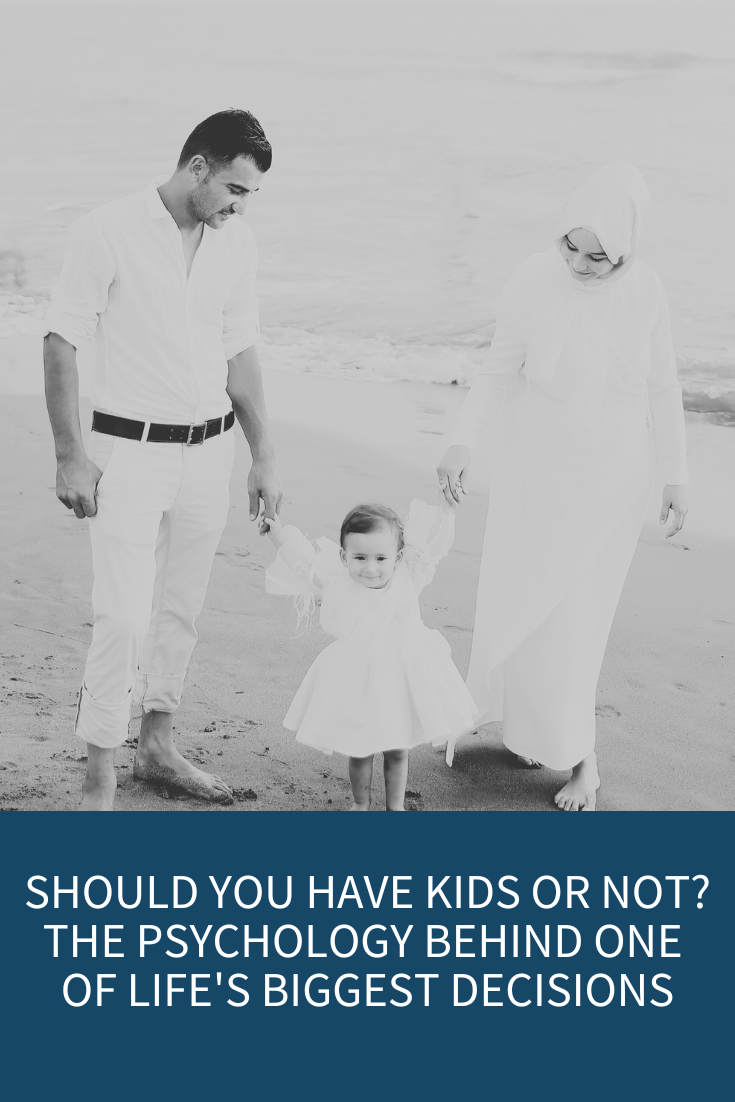
Deciding whether to have kids isn’t just a practical decision. It’s one of the few choices in life that can feel irreversible, identity-shaping, and loaded with expectations you never asked for. Maybe part of you imagines a future with children and feels something warm and meaningful. And another part of you imagines the same future and feels panic, grief, or a quiet sense of “I’m not sure this is for me.” In this episode, I’m breaking down what the research actually says about parenthood, happiness, and meaning, why this decision feels so emotionally charged, and the five questions that genuinely help you figure out what you want, not what you’re supposed to want. If you’ve ever felt stuck between fear, pressure, and honesty about your own life, this episode is for you.
10-minute read
Introduction
Deciding whether to have kids is one of the few choices in life that feels both deeply personal and strangely public at the same time. It’s not just a practical decision about finances, schedules, or biology. It’s an identity decision. It’s a cultural decision. It’s a relational decision. And for many people, it quietly feels like a test of whether they’re living life “correctly”.
If you say you want children, people often assume you’re nurturing, mature, and emotionally complete. If you say you don’t, it’s often assumed that you’re selfish, afraid, emotionally damaged, or destined for regret. Underneath all that noise, most people are left with a much quieter and more unsettling question: What do I actually want, and how do I know if I can trust that answer?
To make sense of that question, it helps to start with something surprisingly grounding: what research actually says about parenthood, happiness, and meaning.
Happiness vs Meaning with Parenting
Parenthood is not a universal happiness upgrade, and it’s not a universal misery sentence either. On average, the effect of having children on happiness is modest, but the effect on meaning tends to be stronger. Whether parenting feels fulfilling or draining depends less on personality and more on context, including money, support, partner dynamics, work flexibility, health, and whether having children feels like a genuine choice rather than an obligation. And these studies hold relatively steady across cultures.
Multiple studies show that parents often experience more daily stress, fatigue, and negative emotion than non-parents, especially during the years when children are young. Mothers, in particular, tend to carry a disproportionate share of emotional and logistical labor, which strongly affects wellbeing. At the same time, parents often report a stronger sense of meaning and purpose in life. Now, remember as we’re talking about all this that meaning and happiness are not the same thing. Psychological research shows that a meaningful life and a happy life overlap, but they are distinct experiences with different emotional patterns.
One simple way to think about it is this: happiness is about how you feel during your day, and meaning is about how you feel about your life. Children can increase meaning without necessarily increasing day-to-day happiness. That doesn’t make parenthood good or bad, but it does make it complex. And complex decisions require better questions than “Do I want kids or not?”
The Five Questions to Ask Yourself Before Deciding to Have Kids
Question One: Reality vs Identity
The first question is whether you want the reality of parenting or the identity of being a parent.
A lot of people imagine parenthood in symbolic terms. In your head, it might sound like, “I love the idea of holidays with kids,” or “I want to feel like a real family,” or “I don’t want to miss out on that experience.” Those thoughts are understandable, but they’re not about the mechanics of parenting. They’re about the meaning and image of it.
A more honest version of the question sounds like, “Do I actually want the daily structure of parenting?” That might sound like, “Do I want years of interrupted sleep, endless logistics, school emails, emotional regulation, financial responsibility, and the mental load of anticipating everyone else’s needs?” It might sound like, “Do I want to negotiate bedtimes, homework, social drama, and teenage rebellion?” Or even, “Am I okay with a life where my time is rarely fully mine again?”
Research shows that when people idealize parenthood and underestimate its demands, the gap between expectation and reality becomes a major source of stress and disappointment. This doesn’t mean you should or shouldn’t have children. It means clarity comes from imagining ordinary days, not just beautiful moments.
Question Two: Values vs Fear
The second question is whether your decision is coming from values or from fear.
Fear pushes people in both directions. If you lean toward having kids, your inner dialogue might sound like, “What if I regret not having them?” or “What if I end up alone?” or “What if this is my only chance to feel real purpose?”
If you lean toward not having kids, your thoughts might sound like, “What if I lose my freedom?” or “What if my relationship changes in ways I can’t control?” or “What if I’m not cut out for this?”
A values-based decision usually feels quieter and steadier. It sounds like, “This aligns with how I want to live, even though I understand that it’ll be hard.” A fear-based decision often feels urgent and pressured, like you’re trying to escape a future you’re terrified of.
Psychologically, decisions driven primarily by fear tend to predict lower long-term satisfaction in major life choices. You don’t need perfect certainty, but you do need to notice whether your decision feels like alignment or like escape.
Question Three: Real vs Fantasy Support
The third question is about your real support system, not your fantasy one.
In your head, fantasy support often sounds like, “We will figure it out,” or “My partner will step up,” or “Love will carry us through.” Real support sounds more concrete. It sounds like, “How does my partner handle stress now?” “Who does the emotional labor in our relationship?” “When we’re both tired, who sacrifices?” “How do we handle conflict when things are already hard?” “Who would actually help us on an ordinary Tuesday night when everything feels overwhelming?”
Research consistently shows that equitable partner support is one of the strongest predictors of parental wellbeing, especially for women. When the division of labor is unequal, stress, resentment, and burnout increase dramatically.
This is where shame often enters the decision. Many women feel pressure to say yes to motherhood even when they can see that their relational context is not emotionally or practically supportive. Noticing that reality isn’t cynicism, it’s psychological honesty.
Get my top five tips for knowing if you’re making the right decision and listening to your gut.
Question Four: Loss of Control
The fourth question is how you handle loss of control and autonomy.
Parenthood isn’t just about love. It’s about surrendering predictability.
In your head, this might sound like, “I need quiet to feel regulated,” or “I like routines,” or “I value spontaneity,” or “I don’t like being needed all the time.” It might also sound like, “I don’t mind chaos,” or “I like being needed,” or “I feel energized by caretaking.”
Research suggests that people who strongly value autonomy and predictability tend to experience higher parenting stress unless they have strong buffers such as financial stability, relational support, and flexible work structures. This isn’t about being selfish or nurturing. It’s about temperament. Some nervous systems thrive in caregiving environments. Others feel chronically dysregulated by them. Neither is morally superior, but pretending otherwise can be psychologically costly.
Question 5: Where’s Your Meaning?
The fifth question is where meaning will come from in your life either way.
Parents often report greater meaning in life, even when they’re not happier. And the research also shows that non-parents can experience deep meaning, of course, and it’s when they intentionally cultivate connection, contribution, creativity, and purpose.
In your head, this might sound like, “If I have kids, will they become the center of my identity?” or “If I don’t have kids, will I feel adrift?” or “If children become my only source of meaning, what happens when they grow up, pull away, or disappoint me?” Children can be a source of meaning, but they can’t be the only source of meaning without emotional consequences for everyone involved. A psychologically healthy life, with or without children, requires multiple sources of purpose.
And there’s something people rarely admit to themselves, but that needs to be discussed here, and that’s resentment. Would you resent doing everything yourself or losing career momentum? Would you resent the financial pressure, feeling invisible, or a partner who gets to keep their life while you lose a lot of yours?
Noticing that you’d have resentment in these types of situations isn’t a character flaw, it’s information. In fact, there’s quite a bit of research showing that resentment predicts lower relationship satisfaction and parental wellbeing more strongly than stress itself. If you can name potential resentment early, you sometimes can prevent it. If you ignore it, it tends to grow quietly.
Wrapping Up the Questions
When researchers look at parents who report higher wellbeing, several patterns appear again and again.
- Parents tend to fare better when they experience real partner equity, not just verbal promises.
- They tend to fare better when they feel financially stable or at least financially in control.
- They tend to fare better when they experience parenthood as a choice rather than an obligation.
- They tend to fare better when they have realistic expectations rather than idealized fantasies.
- They tend to fare better when their relationship was strong before children arrived.
- They tend to fare better when they have psychological flexibility and tolerance for uncertainty.
Children do not fix relationships. Instead, they amplify whatever’s already there. If a relationship is secure, children can deepen it. If a relationship is fragile, children tend to expose the cracks.
To Freeze or Not to Freeze?
I don’t think today’s conversation could be complete without discussing the idea of whether you should freeze your eggs. On the positive side, egg freezing can extend reproductive options and reduce time pressure for women who aren’t ready to decide yet. For some women, freezing eggs reduces anxiety and creates psychological breathing room.
But there are important limitations. Egg freezing isn’t an insurance policy. Professional guidelines emphasize uncertainty and variable success rates. Many women never use their frozen eggs, and outcomes vary widely depending on age, health, and later fertility factors. Medical risks exist, including complications from ovarian stimulation and retrieval. Costs are significant and ongoing, including procedures, medications, storage, and potential future IVF.
There’s also a psychological risk that’s rarely discussed. Egg freezing can be empowering, and it can also become a way to postpone a decision that feels emotionally overwhelming. The honest question isn’t “Should I freeze my eggs?” It’s “Am I using this to buy time to think, or to avoid thinking?”
If you’re listening to this and still feel torn, that makes sense. This decision isn’t just intellectual. It is emotional, relational, and practical all at once. The free download for today is The Kids Decision Snapshot, which will help you start to think this through in a grounded way without pushing you toward any answer. If this is a bigger issue you’ve been wrestling with, I’m going to gently encourage you to get the Therapy-to-Go bundle so you can dive deep on this question and find an answer that fits for your life.
Final Thoughts
In the end, you’re not choosing between a good life and a bad life. You’re choosing between two different lives, each with its own grief, meaning, constraints, and joys. Having children means grieving the life you will not have. Not having children means grieving the life you will not have.
There’s no neutral option, but there’s an honest one.
Therapy-to-Go Bundle
- The Kids Decision Snapshot: will help you start to think this through in a grounded way without pushing you toward any answer.
- The Parenthood Decision Map: A deeper, therapy-level framework to help you think clearly about whether you want kids.
- Relationship Reality Check: A therapy-level tool to understand how your relationship would actually handle parenthood.
- Autonomy and Nervous System Profile: A therapy-level tool to understand how your nervous system and autonomy needs would actually experience parenthood.
- Meaning and Identity Map: A therapy-level tool to explore who you are with kids, without kids, and beyond both.
- Regret and Resentment Simulator: A therapy-level tool to explore the emotional trade-offs of having kids and not having kids.
Buy the bundle now for $10 and get all the above. OR join Abby’s One Love Collective and get a Therapy-to-Go Bundle for each episode, plus ad-free episodes of the podcast, live Q&A’s with Dr. Abby, and access to an amazing community that’s all about real growth.
Resources for How to Decide Whether to Have Kids: The Psychology and 5 Questions That Bring Real Clarity
Is Toxic Shame Hurting Your Relationship and You Don’t Realize It?
How Do You Know If You’re Making the Right Decision/Following Your Gut
American Society for Reproductive Medicine. (n.d.). Planned oocyte cryopreservation.