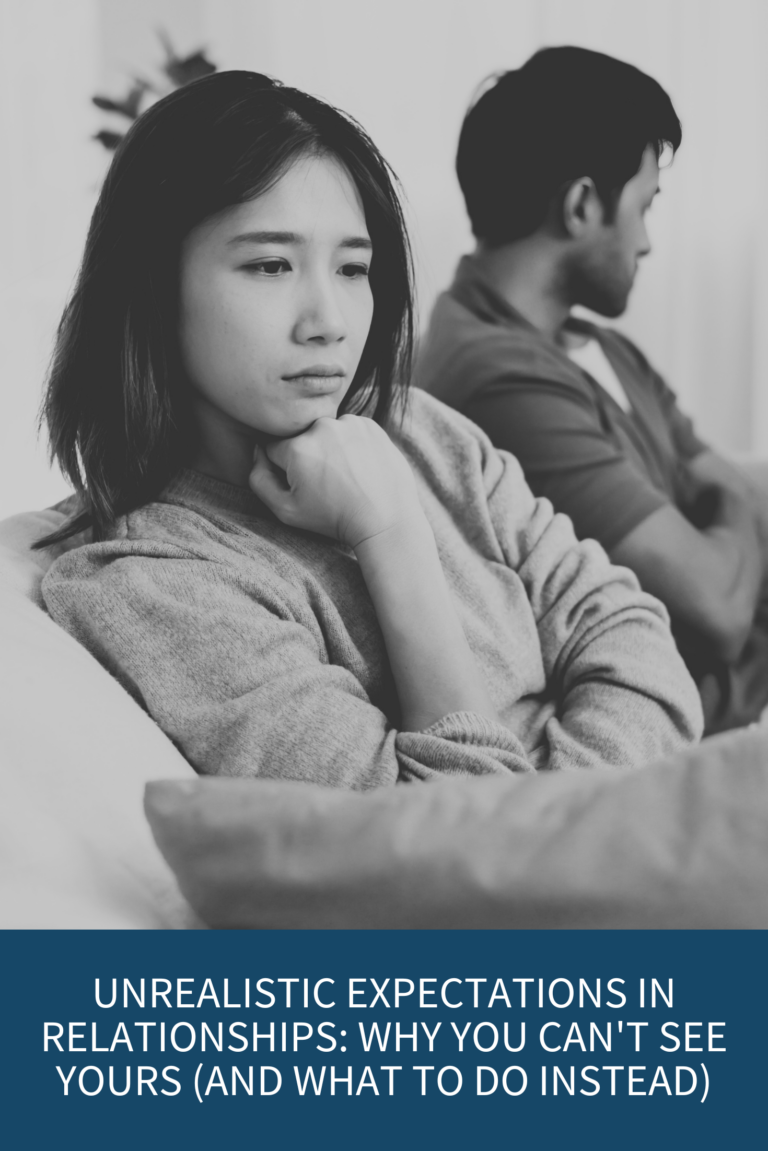



You were perfectly nice to the guy at the coffee counter this morning, and you were patient with the coworker who asked you the same question for the third time, and then you walked through your own front door and said something to the person you love most that you would never in a million years have said to either of those strangers. So, if you’ve ever thought, why am I so mean to the people I love, today’s episode is for you.
10-minute read
The short version is that everywhere else in your life you’re choosing your behavior one interaction at a time, and at home you’ve stopped choosing, because your brain runs on something called context and the people you love are the most repeated context you’ve got. As always, I’m going to give you all the science and the background behind what context really is, and then I’ll give you the three steps to Stop Running on Autopilot with the People You Love.
Why Am I So Mean to the People I Love Most?
Let me start by saying there isn’t one reason you’re sometimes meanest to those you love the most. You might be exhausted because you didn’t sleep last night, had a terrible day at work, or grew up in a house where this is just what people did with their stress. All of that’s real, and it counts. But underneath all those reasons is usually something else: you’re on autopilot with the people you’re closest to, and you’re not on autopilot in that same way with anybody else. Your worst behavior isn’t aimed at the people you love; it’s just the only behavior you’ve got that gets to run without any supervision, and they happen to be the ones standing there when it runs.
So yes, you’re patient with total strangers, and then get home, and you’re horrible to your partner or dad, and you don’t understand it. Which usually brings you to a story you start telling yourself about what this means. Your inner narrative is usually something like, does this mean I really don’t love this person? Or, am I a bad person who happens to be good at faking it in public?
You’re not a bad person. This isn’t a character problem; it’s more of a mechanical one. What you’re looking at isn’t evidence about your personality or your heart; it’s evidence about how repetition works.
Isn’t It Just the Kick-the-Dog Effect?
I googled this question when I was researching it and saw a lot of the same answer pop up, which basically boiled down to displaced aggression. Your boss was awful, you couldn’t yell at your boss because you’d like to keep paying your bills, so the anger has to go somewhere, and it lands on whoever’s standing in your kitchen when you get home. Basically, you kick the dog.
And I’m not saying that displaced aggression isn’t a thing, of course. There’s lots of research on it, and it’s real. I’m sure displacement happens in your life. It’s just not the answer to this particular question, because if displacement were the whole issue, then that anger would go everywhere, and it generally doesn’t. Now, I know you’re not a saint and might have gotten short with your neighborhood barista this morning for getting your coffee order wrong, or maybe that was you I saw giving me the finger in traffic yesterday because you thought I cut you off. That happens, but it’s not happening every day, to everyone you meet, the way it’s happening at home.
So, displacement tells you the anger had to go somewhere. What it doesn’t tell you is why it keeps going to them and not to everybody else.
The Bigger Thing Sitting Underneath All of It
Researchers have found that roughly 43% of what you do in a day is something you do almost every day, in the same spot, and most of the time you’re not even thinking about it while you do it. In other words, almost half the time, you’re not choosing what you’re doing in the moment. You’re just running on autopilot. Which means your day isn’t mostly made up of thoughtful or mindful decisions. Your day is mostly made up of triggers, and the trigger is usually the place you’re standing in.
So think about your own life for a second here. How many times have you walked into your own kitchen, or seen your partner’s face across a table, or heard that particular sigh your mother makes on the phone? It’s probably thousands of times, and nothing else in your life is even in the neighborhood. Your coworkers change, the barista changes, and the setting changes, so out there you have to show up and pick your behavior every single time, and because you have to, you do.
Your home is your most stable and repeated place, which means it’s where your habits are strongest. That matters because of something researchers found when they pulled together 64 studies on how well anybody predicts their own behavior. When a behavior has been repeated enough in a steady setting, what you did last time is what predicts what you’ll do next, and choice takes a back seat. It’s only when the behavior is new to you, or the setting keeps shifting, that you’re really choosing at all. So, thinking it through and choosing works, but only where a habit hasn’t formed yet, which is pretty much everywhere except at home with the people you live with.
You’re not choosing worse with the people you love; you’re choosing less, and most of the time you’re not choosing at all.
That gap, between what you meant to do and your knee-jerk reaction, what your body did before you decided anything, is the thing I ended up writing a whole book about called Stop Reacting, Start Connecting. The reason it’s so much harder at home isn’t that you don’t care enough about them; it’s that home is precisely the place where caring stopped being the automatic response.
But Don’t I Understand Them Better Than Anyone?
You’d think so, but the research says the opposite!
Kenneth Savitsky, Boaz Keysar, and Nicholas Epley ran a series of experiments on something they named the closeness-communication bias. They had people try to get a specific meaning across using a phrase that could be taken more than one way, sometimes with a stranger and sometimes with a close friend or a spouse. Everybody felt more confident that they’d been understood by the person they were close to, and then the researchers checked how they’d really done; and the spouses did no better than the strangers. Same accuracy, more confidence!
Epley described it as closeness giving you the illusion of insight rather than the real thing, and I think that’s exactly right. With a stranger, you know you have to do the work, so you explain yourself, you give them the context, you check that it landed. With your person, you let your guard down and assume they’re seeing whatever you’re seeing, so you say “it’s fine,” and then you’re genuinely hurt when they go ahead and believe you.
So put those two things side by side and look at what you’re working with. With the people you love most, you’re running on the strongest autopilot you own, you’re doing the least work of anyone to make yourself understood, and you’re the most confident of all that you’re doing is fine. At the end of the day, it’s a setup.
3 Steps to Stop Running on Autopilot with the People You Love
Now, because I am constitutionally incapable of handing you a problem and no plan, let’s talk about what you do about it.
Step 1: Break the Context, Not the Promise
Think about who you are on vacation. You’re nicer on vacation, right? Everybody is. You’re patient, you’re funny, you’re interested in what your partner is saying. Then you get home, and two days later you’re snapping at them in the kitchen about the dishwasher.
We say that’s because vacation is restful. Sure, it is. But something bigger is going on, and it’s this: on vacation, none of your stuff is around you. Not your kitchen, not your front door, not that chair. And your stuff is what tells you what to do.
That’s all a habit is. You do the same thing in the same place enough times, and your brain hooks the place to the thing. After that, the place does the work for you. You walk in your front door, and the snapping is already loading up before your coat is off, and you didn’t pick that. The door picked it.
And this isn’t just me talking. Research shows that when you land somewhere new, the only habits that come with you are the ones where a piece of the surroundings came too. Everything else just stops.
Now think about yourself in Cabo. You weren’t trying harder. You weren’t more motivated, you weren’t more disciplined, and you didn’t work on yourself on that plane. You were just somewhere that wasn’t set up to make you snap. Motivation isn’t what does it. It’s the change of scene.
So, stop making promises to yourself in the car on the way home and instead find the one repeated setting where you’re reliably at your worst. And I don’t mean “my marriage,” I mean the actual coordinates of it: the first ten minutes after you walk in the door, or the kitchen between dinner and bedtime, or the Sunday phone call at four o’clock. Then change one physical thing about it, so come in through the side door instead, or sit in a different chair, or take that call in front of your house on the sidewalk instead of sunk into the same couch you’ve been having that same conversation on for nine years.
I know exactly how small that sounds, and I want you to do it anyway, because you’re not doing it for the symbolism of it. You’re doing it because when the cue goes missing, the automatic response has nothing to fire on, and in that little gap where nothing happens, you get a vote again.
Step 2: Say the Extra Sentence
This one comes straight out of the research I mentioned earlier, and it costs you about four seconds. There’s one thing you do automatically for strangers that you’ve stopped doing for the person you love, and it’s the extra sentence, the one where you explain yourself. With a stranger you’d say, “Hey, would you mind moving your bag? I’ve got a bad back and I’m trying to sit down.” With your partner you say, “Seriously?” and point at the bag, because after fifteen years surely they know about your back, and if they’re not moving it then it must mean something about how they feel about you. But it doesn’t mean a thing about how they feel about you; they just didn’t see the bag, and you’ve gone and built an entire case about it. It’s a story you’re telling yourself, not the facts.
So, overexplain to the people you love in exactly the way you’d overexplain to a stranger. Say the part you think is obvious, and then say the part you’re certain they already know, and yes, it’s going to feel a little ridiculous at first, but give it a try. And when I say “overexplain,” of course I don’t mean justify for 10 minutes. I’m just trying to point out that you want to add that extra sentence or two.
And because this is a lot easier to believe in your own handwriting than it is coming out of my mouth, my free download for this episode helps you do exactly this. I’m calling it What Would You Have Said to a Stranger? It’ll take you two minutes, and it’ll help.
Step 3: Name the Direction Before You Open Your Mouth
Everything you do in a relationship is a move, and there are only two directions it can go: toward the person or away from them. A sharp tone is away; a real question is toward; your phone in your hand while they’re telling you about their day is away, and putting it out of sight is toward. We both know there’s a whole lot of what you’ve been calling being tired, but it’s really just a move away that you never counted as one.
So, before you open your mouth, ask yourself one question: toward or away? That’s it.
And, of course, you need to be mindful and in your moments to stop and notice when/how you’re doing this, so if you haven’t downloaded my free Mindfulness Starter Kit by now, I’m not sure what you’re waiting for.
Therapy-to-Go Bundle
- What Would You Have Said to a Stranger?
- The Autopilot Worksheet
- The Context Disruption Menu
- Is This a Habit or Is This a Conflict Assessment
- Toward or Away: The Four-Word Check
- The One-Week Tracker
- Journaling Prompts
References
- Marcus-Newhall, A., Pedersen, W. C., Carlson, M., & Miller, N. (2000). Displaced aggression is alive and well: A meta-analytic review. Journal of Personality and Social Psychology, 78(4), 670-689.
- Wood, W., Quinn, J. M., & Kashy, D. A. (2002). Habits in everyday life: Thought, emotion, and action. Journal of Personality and Social Psychology, 83(6), 1281-1297.
- Ouellette, J. A., & Wood, W. (1998). Habit and intention in everyday life: The multiple processes by which past behavior predicts future behavior. Psychological Bulletin, 124(1), 54-74.
- Savitsky, K., Keysar, B., Epley, N., Carter, T., & Swanson, A. (2011). The closeness-communication bias: Increased egocentrism among friends versus strangers. Journal of Experimental Social Psychology, 47(1), 269-273.
- Wood, W., Tam, L., & Guerrero Witt, M. (2005). Changing circumstances, disrupting habits. Journal of Personality and Social Psychology, 88(6), 918-933.