


If you love someone who needs a lot of reassurance, clarity, or emotional check-ins, this episode is for you. Today you’ll learn what anxious attachment is actually responding to, why reassurance doesn’t work long-term, and how to love an anxious partner in a way that creates real safety without losing yourself in the process.
12-minute read
Introduction
Loving an anxiously attached partner can feel confusing. You might care deeply about this person and still feel like you’re constantly managing the emotional temperature of the relationship. You watch your tone. You think about timing. You replay conversations in your head, wondering if something small landed the wrong way. You might reassure, explain, and adjust, only to find yourself doing it again a few hours or days later. Over time, that can turn into exhaustion, pressure, or quiet resentment, even when there’s a lot of love. Yes, compassion fatigue is a real thing.
Now, I want to be clear. This episode isn’t about shaming anyone with anxious attachment or telling them they’re too much. It’s about understanding what someone with an anxious attachment style is navigating internally when they’re in a romantic relationship and why relationships start to strain when reassurance becomes the main strategy for staying connected.
In the last episode, we talked about the anxious–avoidant dynamic and why it’s so common and painful. Today, we’re slowing things down and focusing on one side of that dance. We’re talking about how to love an anxiously attached partner in a way that builds real, long-term safety, not just momentary relief, and how to do that without abandoning yourself along the way.
What Anxious Attachment Actually Is (and What It Isn’t)
Anxious attachment develops when early experiences of closeness were inconsistent, unpredictable, or emotionally unreliable. The nervous system learns that connection matters deeply, but it isn’t guaranteed.
As an adult, this doesn’t usually show up as low self-esteem or drama. It shows up as hyper-attunement. They notice shifts in tone, timing, energy, and responsiveness quickly because their body is wired to protect connection. Anxious attachment isn’t about wanting constant attention or being manipulative. It’s about a nervous system that learned to stay alert so love wouldn’t disappear.
Research shows that adults with anxious attachment demonstrate heightened emotional reactivity and increased threat sensitivity in close relationships, particularly during moments of perceived relational uncertainty. This is physiology, not personality.
Anxious Attachment Isn’t One Thing: Common Anxiety Strategies in Love
Anxious attachment doesn’t show up the same way for everyone. Under stress, people use different strategies to try to feel safe. These aren’t fixed subtypes or labels. They’re learned responses.
One common strategy is reassurance-seeking. When connection feels uncertain, reassurance feels urgent. Even after reassurance is given, the calm doesn’t last long because the underlying fear hasn’t been addressed.
Another common strategy is hypervigilance. An anxiously attached person will scan for emotional shifts constantly. A delayed text or distracted tone becomes meaningful because their nervous system fills in the worst-case scenario.
A third strategy I see is that when fear peaks, anxiety can turn into emotional intensity. Arguments escalate, old issues resurface, or distance is threatened, not because someone wants conflict, but because emotional activation feels better than emotional absence.
Research shows that all these strategies are attempts to regulate distress and reestablish proximity, not conscious efforts to control a partner.
What Loving an Anxiously Attached Partner Often Feels Like
If you love someone with anxious attachment, the relationship can feel deeply connected and deeply draining at the same time. You may feel appreciated and needed, but also scrutinized. You may feel close one moment and under a microscope the next. Neutral moments often require explanation. Emotional reassurance can feel endless.
Over time, you may start preemptively managing their emotions. You may explain yourself before being asked. You might avoid space, silence, or honesty because you don’t want to trigger their anxiety.
This means the relationship has slowly recruited you into the role of nervous-system stabilizer. That role creates burnout and resentment if it becomes permanent.
How Do You Love an Anxiously Attached Partner Without Making Things Worse?
This is the question I get asked a lot. And the answer isn’t more reassurance. It’s structural safety. In a romantic relationship, structural safety refers to a stable, reliable framework built on mutual trust, respect, and consistent commitment that allows both partners to be their authentic selves without fear of judgment, harm, or abandonment. It’s the underlying “container” that allows a relationship to be resilient and thrive.
Reassurance works in the moment because it calms the nervous system temporarily. Research shows anxious attachment is associated with increased amygdala activation during perceived relational threat, meaning fear responses fire quickly and powerfully.
But reassurance alone doesn’t retrain the nervous system. In fact, the research consistently shows that excessive reassurance can increase dependency and anxiety over time because calm only comes from the outside. The anxiously attached person needs to learn how to calm from the inside.
Lasting safety is built through patterns, not promises.
The 5 Research-Backed Ways to Love an Anxiously Attached Partner
If you strip anxious attachment down to its core, it’s driven by fear of sudden emotional loss. These five principles don’t try to eliminate anxiety. They create the conditions where anxiety doesn’t have to run the relationship.
As always, each one is supported by decades of attachment and relationship research.
And before I jump into all the tips, the free download for today is going to be amazingly helpful to you (if I do say so myself). I call it, Loving an Anxious Partner: 10 Things To Say (and Not Say) When Anxiety Shows Up.
1. Prioritize Predictability Over Emotional Intensity
An anxious nervous system calms through reliability, not grand emotional moments. Predictability shows up in small, unglamorous ways. If you say you’ll call after work, calling when you said you would does more to create safety than a heartfelt explanation later about why the day got away from you. Reliability teaches the nervous system that connection doesn’t disappear randomly. (Bonus, this is also part of the trust triad, so you want to be paying attention to these behaviors and patterns anyway).
This also means following through on emotional conversations. Saying “We’ll talk about this later” only works if “later” actually happens. When hard conversations reliably return to the table instead of disappearing, anxiety softens because the fear of being emotionally abandoned decreases.
Predictability even applies to how you respond to reassurance requests. You don’t need to say more each time, but responding in a similar, calm way helps anxiety know what to expect. Consistency here matters more than saying the perfect thing.
Research consistently shows that predictable partner responsiveness is one of the strongest predictors of perceived attachment security in adult romantic relationships.
2. Name Emotions Without Rushing to Fix Them
Anxious attachment doesn’t calm because the logic is convincing. It calms because the emotion is acknowledged. I’m going to say that again. Anxious attachment doesn’t calm because the logic is convincing. It calms because the emotion is acknowledged. When you jump quickly into reassurance or problem-solving, you may accidentally signal that fear is something to get rid of. Naming the emotion instead tells the nervous system it’s not alone.
For example, saying “I can see this brought up fear for you” or “It makes sense that you’d feel uneasy here” helps regulate emotional arousal more effectively than explaining why everything is actually fine.
Neuroscience research shows that emotional labeling activates regions of the brain associated with regulation and reduces activity in threat-related areas like the amygdala. Feeling seen physiologically lowers alarm.
You’re not endorsing the fear. You’re acknowledging the experience.
Breaking emotional patterns is manageable with the right tools. Find out how to do it right here.
3. Be Clear About Timing, Not Just Intention
Ambiguity is gasoline for anxious attachment. Saying “We’ll talk later” or “I’ll get back to you” often increases anxiety because there’s no edge for the nervous system to hold onto. Clarity creates containment.
For example, saying “I can’t talk tonight, but I can talk tomorrow morning right after breakfast” allows the anxious system to stand down because uncertainty has been replaced with structure.
This also applies to space. Asking for space without naming its length can feel like emotional disappearance. Naming when you’ll reconnect protects closeness even during separation. “I need to take a break right now so I can collect myself. Let’s reconvene in an hour.”
Research shows that uncertainty around availability is one of the strongest predictors of attachment anxiety activation. Specific timing reduces perceived threat.
Getting comfortable with uncertainty will create more calm and freedom in your life. Here are the steps to do just that.
4. Hold Calm, Consistent Boundaries
Over-accommodating anxiety may feel loving, but it teaches the nervous system that fear must stay loud to be addressed. Boundaries aren’t punishment. They’re structure. Calm, repeated boundaries reduce anxiety more effectively than endless reassurance because they introduce stability.
For example, you might say, “I care about you, and I’m not going to keep answering the same question tonight,” or “I’m happy to talk about this once, but I’m not going to revisit it over and over.” Delivered with warmth and consistency, boundaries help anxiety learn that connection doesn’t depend on intensity.
Research shows that relationships with clear, emotionally warm boundaries are associated with greater long-term security and less relational distress than relationships built on emotional overextension.
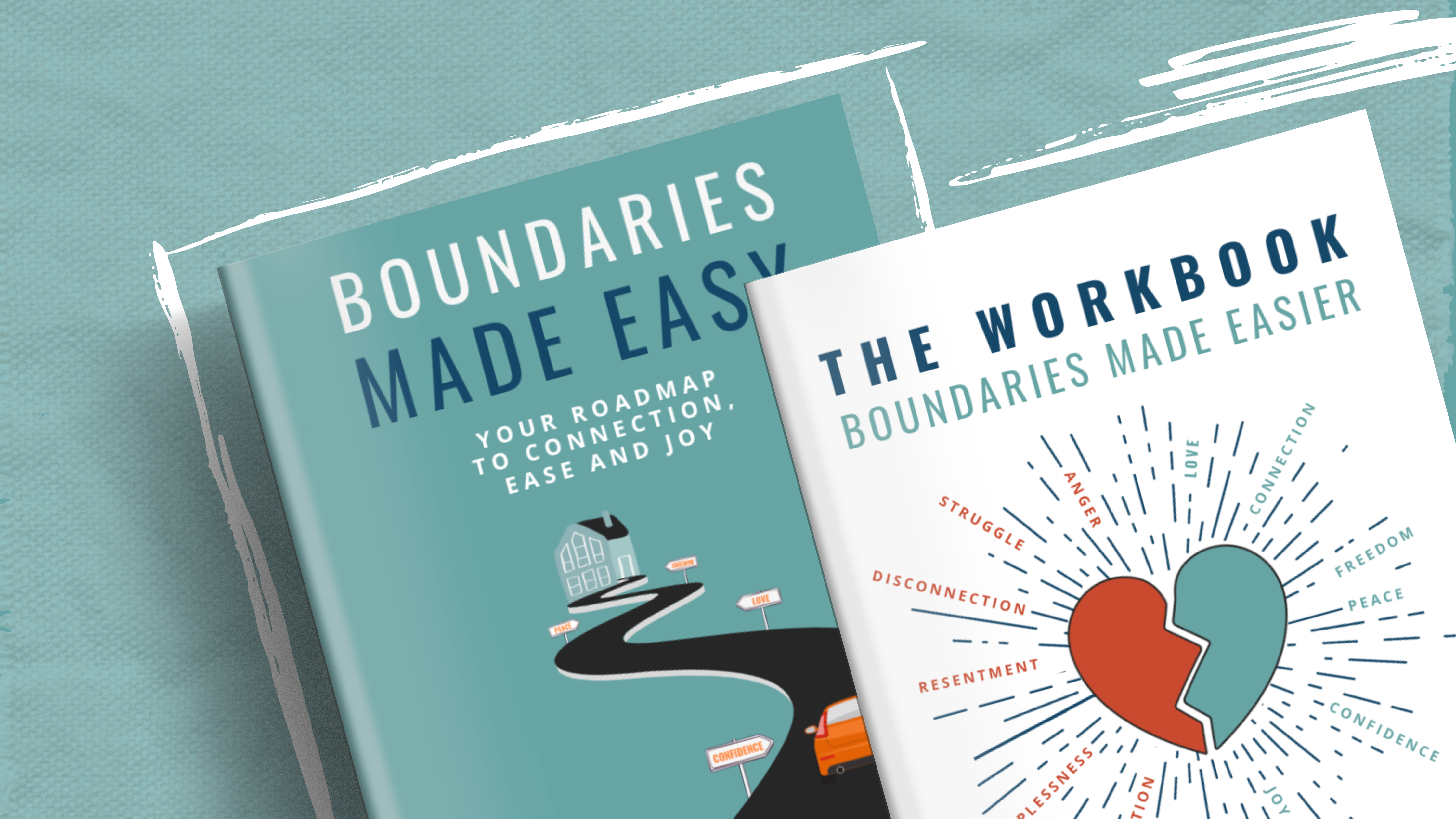
If you’re ready to become skilled at setting and holding boundaries, it’s time to get my Boundaries Made Easy book or my Boundaries Made Easier Workbook.
5. Remember That Regulation Must Be Shared, Not Outsourced
You can support an anxious partner without becoming responsible for their nervous system. Let me repeat this one too: You can support an anxious partner without becoming responsible for their nervous system.
When one person becomes the primary regulator for anxiety, both people lose. The anxious partner doesn’t build internal capacity, and the supporting partner burns out. Healthy relationships allow both people to tolerate discomfort, self-soothe, and return to connection without one person doing all the emotional labor.
Support looks like presence, not rescue. It looks like saying, “I’m here with you,” not “I’ll make this go away.” Research on co-regulation shows that long-term relational stability depends on both partners developing regulation skills, not one partner compensating for the other.
Loving an Anxiously Attached Partner Depending on Your Own Attachment Style
How this relationship feels and what it requires from you depends a lot on your attachment style. The same anxious behaviors land very differently depending on the nervous system on the other side of them.
Understanding this matters, because many people think the problem is just “too much anxiety,” when in reality it’s a mismatch in how fear and closeness are handled.
If you’re more avoidant
If you lean avoidant, anxious behaviors can feel intrusive, overwhelming, or hard to tolerate. Reassurance requests may register as pressure. Emotional check-ins can feel like demands. Your nervous system’s instinct is often to pull back to regain a sense of autonomy, calm, or control.
The problem is that pulling back usually intensifies anxiety, even when you don’t mean it to.
For example, you might feel flooded during an emotional conversation and say you need space, but without clearly naming when you’ll reconnect. For you, space is regulating. For an anxious partner, the lack of timing can feel like abandonment, which escalates their pursuit.
Or you might respond to repeated reassurance requests with distance or irritation because they feel endless. What you experience as self-protection, your partner experiences as withdrawal, which increases their fear and keeps the cycle going.
In this pairing, predictability matters more than increased emotional intensity. You don’t have to become more expressive or emotionally demonstrative. You do need to become more reliable and specific with how you’re feeling, what you’re doing, and when you’ll follow up/reconvene. Calm follow-through and clear timelines do more to soothe anxiety than emotional explanations or pulling further away ever will.
If you’re anxious yourself
When two anxious people pair up, connection can feel instant and deeply bonding, but fear can escalate just as quickly. Both nervous systems are scanning for reassurance. Both are sensitive to shifts. The relationship can become emotionally intense without ever quite feeling steady.
For example, one of you senses distance and seeks reassurance. The other reassures, but then becomes anxious themselves about whether they did it “right.” Reassurance starts bouncing back and forth, but neither of you feels grounded.
Or conflict escalates quickly because both of you are trying to secure the relationship at the same time. Emotional conversations turn into urgency, tears, or repeated processing, which can feel connective in the moment but exhausting afterward.
In this dynamic, learning self-regulation isn’t optional. It’s mandatory. If neither partner can tolerate uncertainty or emotional discomfort, the relationship ends up running entirely on fear. Support is still important, but each person has to develop the capacity to calm themselves, so reassurance isn’t the only way closeness is maintained.
If you’re more secure
If you’re generally secure, loving an anxiously attached partner can be confusing and draining. You may genuinely care and still find yourself wondering why reassurance doesn’t seem to land or why the same concerns keep resurfacing.
For example, you might reassure sincerely, assume the issue is resolved, and then be surprised when it comes up again later. From your perspective, nothing has changed. From your partner’s nervous system, the underlying fear still hasn’t settled.
Or you may find yourself slowly taking on the role of emotional translator, stabilizer, or caretaker without realizing it. You show up consistently, but over time, you feel tired, less spontaneous, or responsible for keeping things calm.
Your role here isn’t to teach security or rescue your partner from their anxiety. It’s to remain grounded, consistent, and clearly boundaried. Secure attachment helps when it offers steadiness, not when it turns into silent over-functioning. Loving an anxious partner doesn’t mean becoming their nervous system for them.
Find Out What to Do When They Need Constant Reassurance and Validation
A Hard Truth Worth Naming
Some anxious relationships become more secure over time. Many don’t. If one partner is doing most of the soothing, repairing, explaining, and adjusting, that’s not intimacy. That’s emotional labor.
Research consistently shows that mutual responsiveness and shared regulation predict relationship satisfaction, while one-sided accommodation predicts burnout and resentment.
Love isn’t enough if safety is missing.
Wrap-Up
Loving an anxiously attached partner isn’t about saying the perfect thing or preventing fear. It’s about understanding what anxiety is responding to, building safety through predictability and follow-through, and holding boundaries that allow both people to stay whole.
In the next episode, we’ll turn to the other side of the dynamic and talk about how to love an avoidantly attached partner without chasing, shrinking, or disappearing.
Today’s Giveaway: Loving an Anxious Partner: 10 Things To Say (and Not Say) When Anxiety Shows Up.
Therapy-to-Go Bundle
- Loving an Anxious Partner: 10 Things to Say (and Not Say) When Anxiety Shows Up
- Journaling Prompts
- Am I supporting or self-abandoning worksheet?
- Predictability That Calms Anxiety
- Loving Without Over-Functioning: Boundaries that calm anxiety without shutting down connection
- Repair After Anxious Moments
Buy the bundle now for $10 and get all the above. OR join Abby’s One Love Collective and get a Therapy-to-Go Bundle for each episode, plus ad-free episodes of the podcast, live Q&A’s with Dr. Abby, and access to an amazing community that’s all about real growth.
Resources for How to Love an Anxiously Attached Partner Without Losing Yourself
Join Abby’s One Love Collective
Anxious-Avoidant Relationships: Why This Romantic Pairing is So Common and So Hard
What is Compassion Fatigue: Signs, Cause and 3 Powerful Tips to Overcome It
How to Be Honest and Build Trust in a Relationship
Breaking Emotional Patterns: The 5-Step Science-Backed Method to Finally Change Your Reactions
Uncertainty: The One Thing You Can’t Avoid
Boundaries Made Easy: Your Roadmap to Connection, Ease and Joy by Dr. Abby Medcalf
The Workbook: Boundaries Made Easier by Dr. Abby Medcalf
How to Stop Rescuing and Start Supporting
How to Heal Yourself Emotionally: Mastering Self-Regulation for a Happier Life
How Your Attachment Style Affects Your Personal Relationships
What to Do When They Need Constant Reassurance and Validation